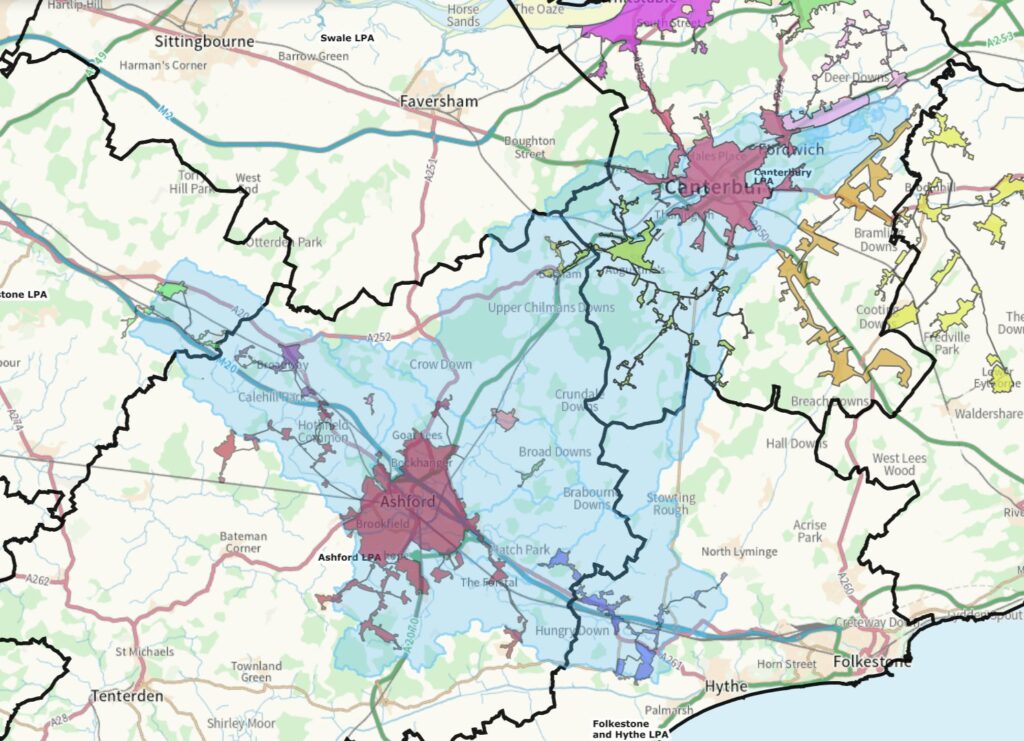
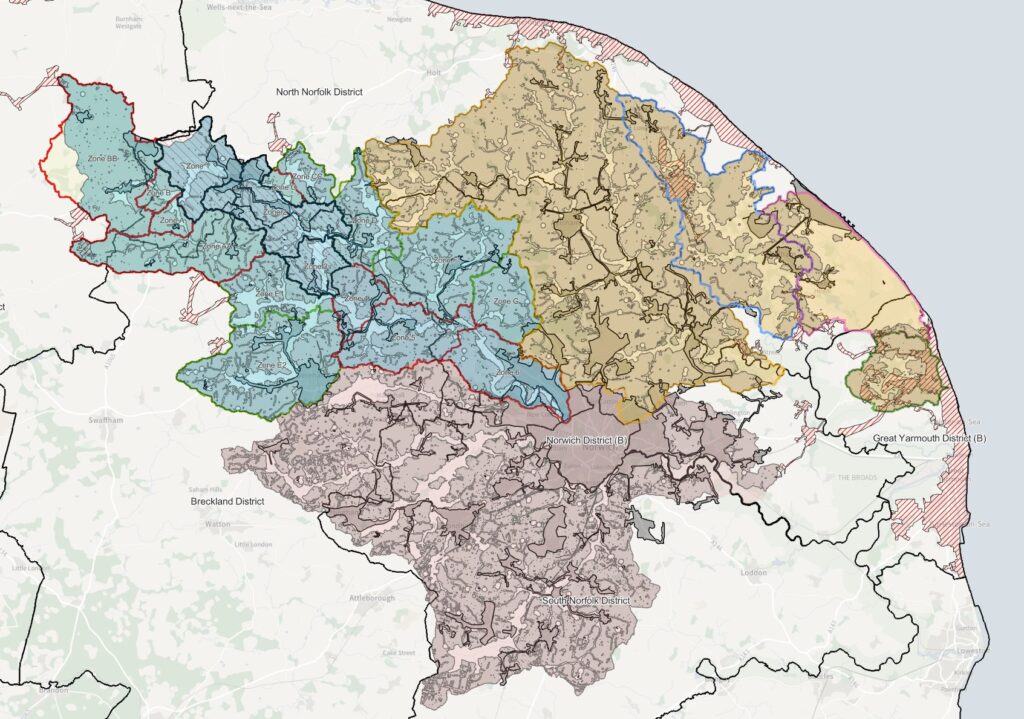
Home owners who live within the river catchment area of the scheme and within the relevant district council boundary are potentially eligible for the scheme. Please take a look at the two maps and it will show you the catchment area.
Kent – The blue shaded area on the Kent map is the catchment area – the darker shaded areas within the blue area indicates that you should have mains sewers available to connect to, although this doesn’t necessarily preclude you from the scheme.
Norfolk – The areas shaded blue, pink and beige are the catchment areas.
If you are on the border or it is unclear as to if you are within catchment then feel free to either register and we will then check or give us a call on 01328 854549.
Please note that whilst it may be disappointing if you are outside of catchment, sometime only by a few meters, these boundaries are set in stone and we have no control over them. We can only advise you if you are within or outside of catchment for the purposes of this scheme.
Please be aware that where you live is only the first step in confirming that your property is eligible for the scheme. There are a number of other checks that we will need to carry out to confirm your full eligibility, including sites surveys, desktop surveys and legal checks.
In March 2022, Natural England passed legislation which effectively prevented local planning departments approving planning applications in certain areas unless the developer (this can be anyone looking to add an extension to their home through to a national house builder) could prove that the proposed development does not add further pollution to the water catchment area of the local rivers. At the time this had a major effect on development of any kind resulting in the approval of the majority of planning applications coming to a standstill. The aim of the scheme is to improve and reduce nutrient export which in turn will improve water quality, water resource usage and habitat creation.
The scheme involves a number of bodies including Natural England, National Rivers Consortium, Norfolk Rivers Consortium, Harrison Civils and the Local Planning Authorities which currently include,Norwich City Council, North Norfolk, South Norfolk, Breckland, Broadland, Ashford and Canterbury District Councils.
The Norfolk Local Planning Authorities have formed a partnership call Norfolk Environmental Credits under which they operate the scheme with us. Kent operates in a similar way under the name Stour Environmental Credits.
We don’t hide the fact that a substantial job such as installing a sewage treatment plant does not come without cost. However the important bit for you is that you, as the homeowner does not have to pay.
Please also see the additional “Costs” section of the FAQ’s
When developers want to build properties they have to show that they are not increasing the pollution within the local rivers.
There are many ways they can do this, but one of them is by helping other homeowners within that same catchment area improve their situation, i.e. by replacing their septic tank with more efficient sewage treatment plants.
In essence therefore, developers within the catchment area are ultimately funding the scheme.
(The definition of a developer can include anyone from a homeowner wanting to extend their property up to a national house builder)
The current owner and any future owner (over the next 90 years) are bound by a unilateral undertaking to look after the new sewage treatment plant, this includes the servicing and maintenance of the plant.
The plant is owned by you at all times and therefore it is just like the roof on your house or your boiler, in that a certain amount of maintenance will be required over the lifetime of the property, this is no different to the sewage treatment plant.
The law, covered by the General Binding Rules stipulates how and when septic tanks and sewage treatment plants can be used and how they should be looked after. Even if you decided that you did not want to sign up for the scheme, as you could afford to pay for the installation of the new sewage treatment plant yourself, you are still obligated to look after, service, maintain and ultimately replace your sewage treatment plant as and when required.
It is our view, there are very few differences in reality as to your obligations, whether you take advantage of the scheme and get a free plant or if you paid for one outside of the scheme.
Yes, the tank itself has a 15 year warranty and all of the serviceable parts come with a 3 year warranty which is provided by the manufacturer, Graf.
Nutrients such as nitrogen and phosphorus provide nutrition for plants and animals and are required for them to grow. They occur naturally in ecosystems, but human activities can increase their supply. An excess of nitrogen and phosphorus can be damaging to the environment because it can lead to eutrophication and algal blooms in rivers and lakes.
The main sources of phosphorus and nitrates in rivers and lakes in the UK are sewage effluent and run-off from agricultural land.
The consortium is made up of specialists in various fields, we have worked together to come up with a solution that has already been tested with the planning departments and has seen planning applications approved using our scheme.
Not necessarily, the development only has to be within the same river catchment area to where the septic tank upgrade takes place. The scheme does not allow developers to build in areas where they couldn’t previously, i.e. outside of the current Local Plans that are in place.
We use a Graf sewage treatment plant, Graf is a German company and the only manufacturer of sewage treatment plants that Natural England will currently approve for nutrient neutral areas under this scheme.
Yes you do, please see the heading below named “Stages”
Yes. There is a contract to sign with us, this covers the installation of the tank and provides us with the permission to access your land to enable us to carry out the work you are asking us to do. It also ties you to us for the first 5 years for the servicing and maintenance of the new plant – please read through the additional questions about servicing under the “Servicing” heading.
There is also a unilateral undertaking between you and the local authority which includes how the property owner needs to look after the plant going forward (See “Post Installation” questions re Servicing and emptying).
Yes, of course, you will be sent a copy of the draft contract and unilateral undertaking once we have carried out the survey on your property and we are happy that we can proceed. This will be prior to you committing to the scheme so that you have time to ask any questions about them. If for any reason you would like to see copies prior to that stage then please just give our office a call on 01328 854549 and we will be happy to email you a copy.
Take a look at the reviews from homeowners that have already been through the process and see what they have to say. You can then compare these with other companies who claim to offer a similar service.
As well as looking at the Google Reviews you can also gain comfort that we have been through a lengthy and detailed tendering process with the local authorities that enable us to carry out the scheme on their behalf. Do feel free to compare what we can offer to other companies but always ensure that you are comparing like for like and that they are working directly for the local authority.
You will receive a Graf One2Clean Sewage Treat Plant which will be sized according to the size of your property and in conjunction with the current building regulations.
Further details about the Graf Sewage Treatment Plant can be found here https://www.grafuk.co.uk/product/one2clean-sewage-treatment-plant/
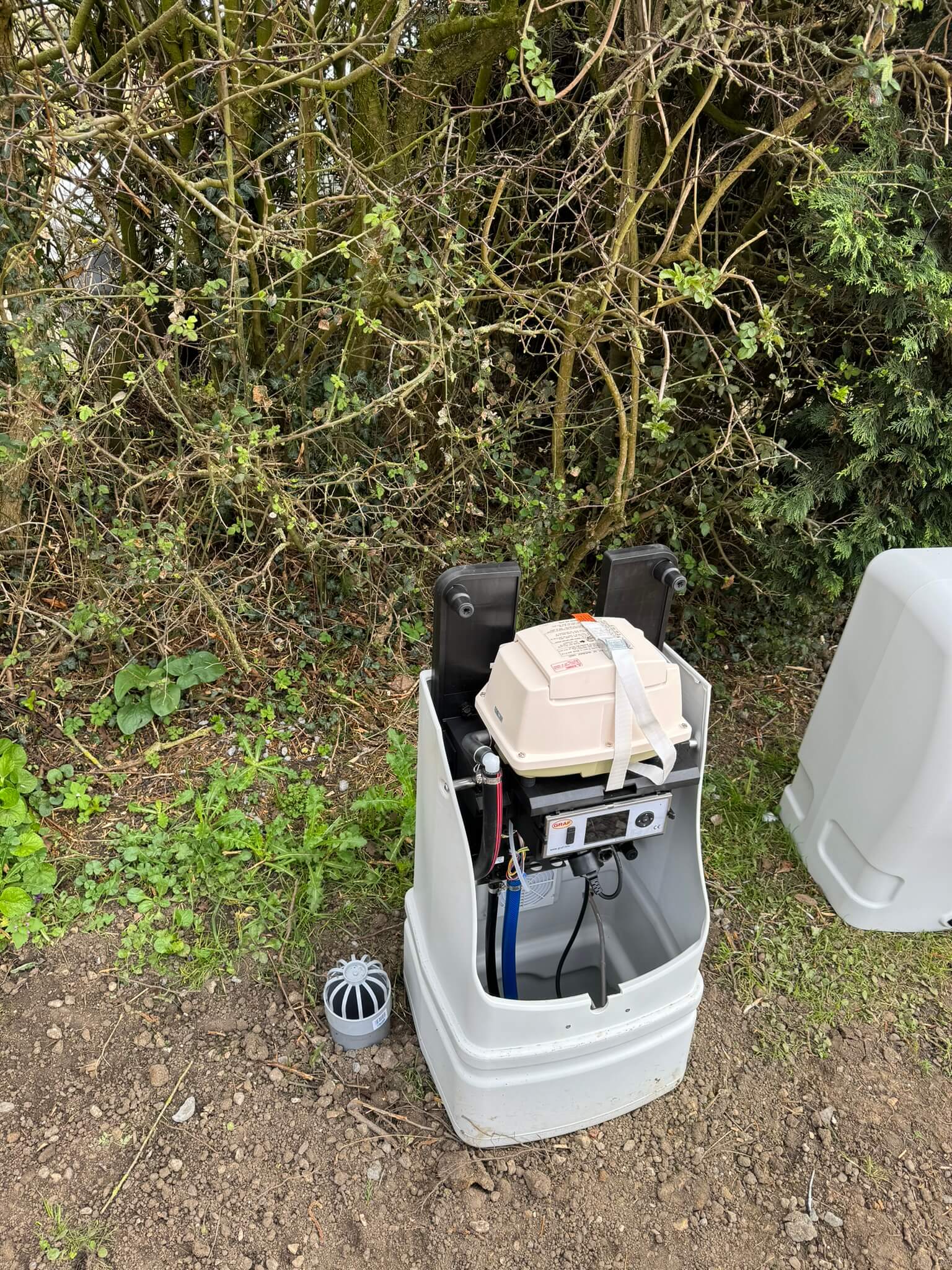
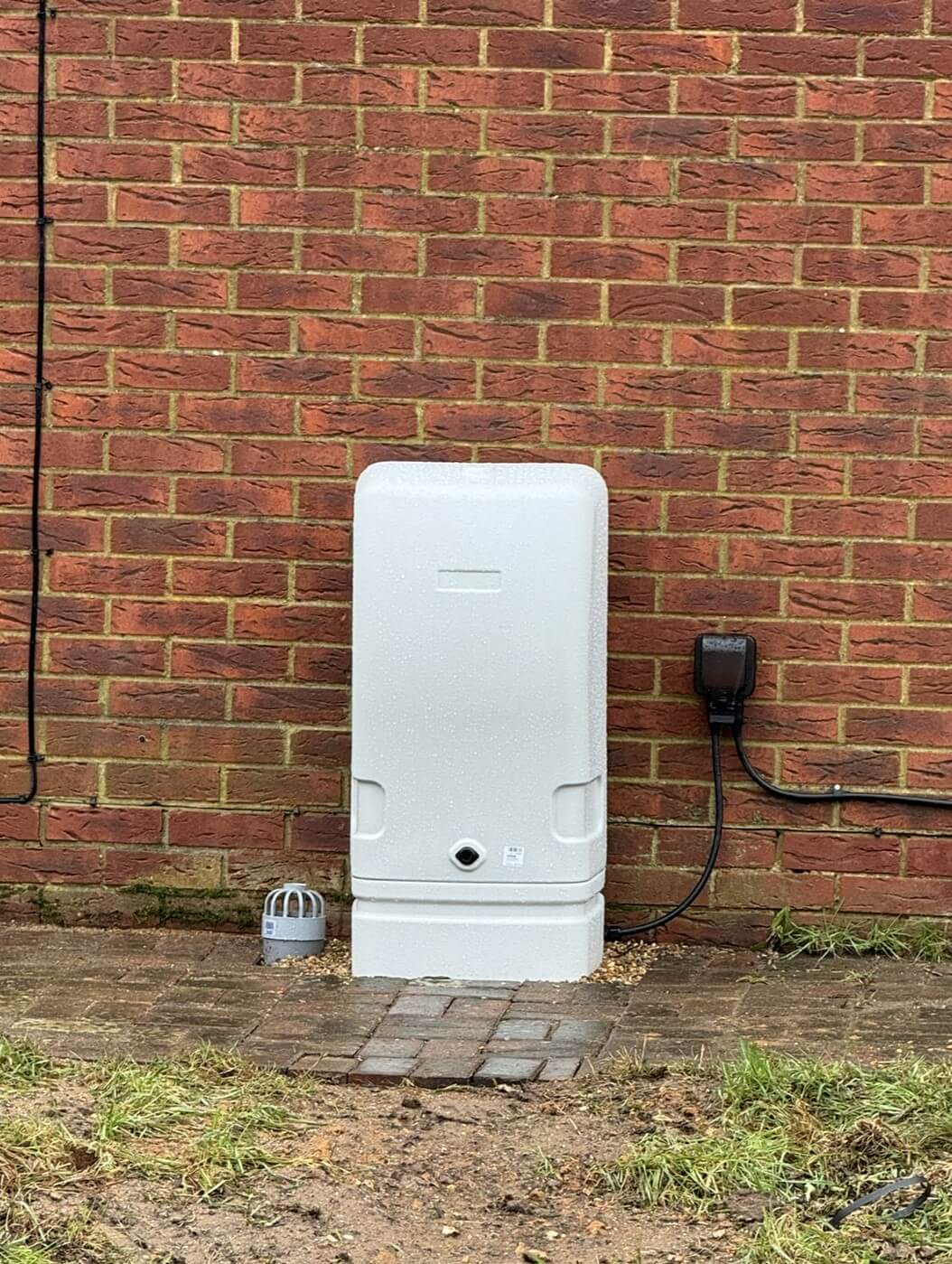
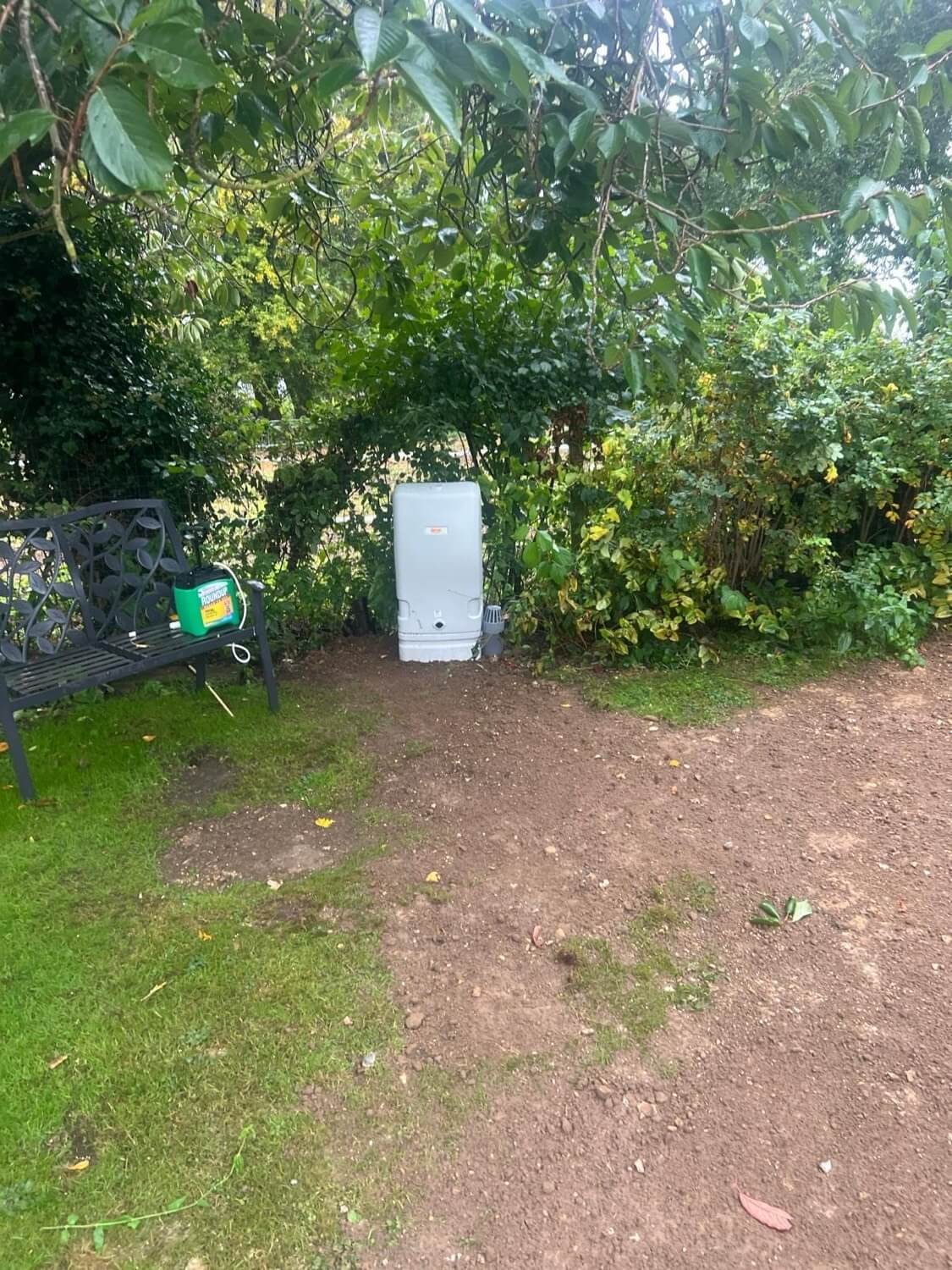
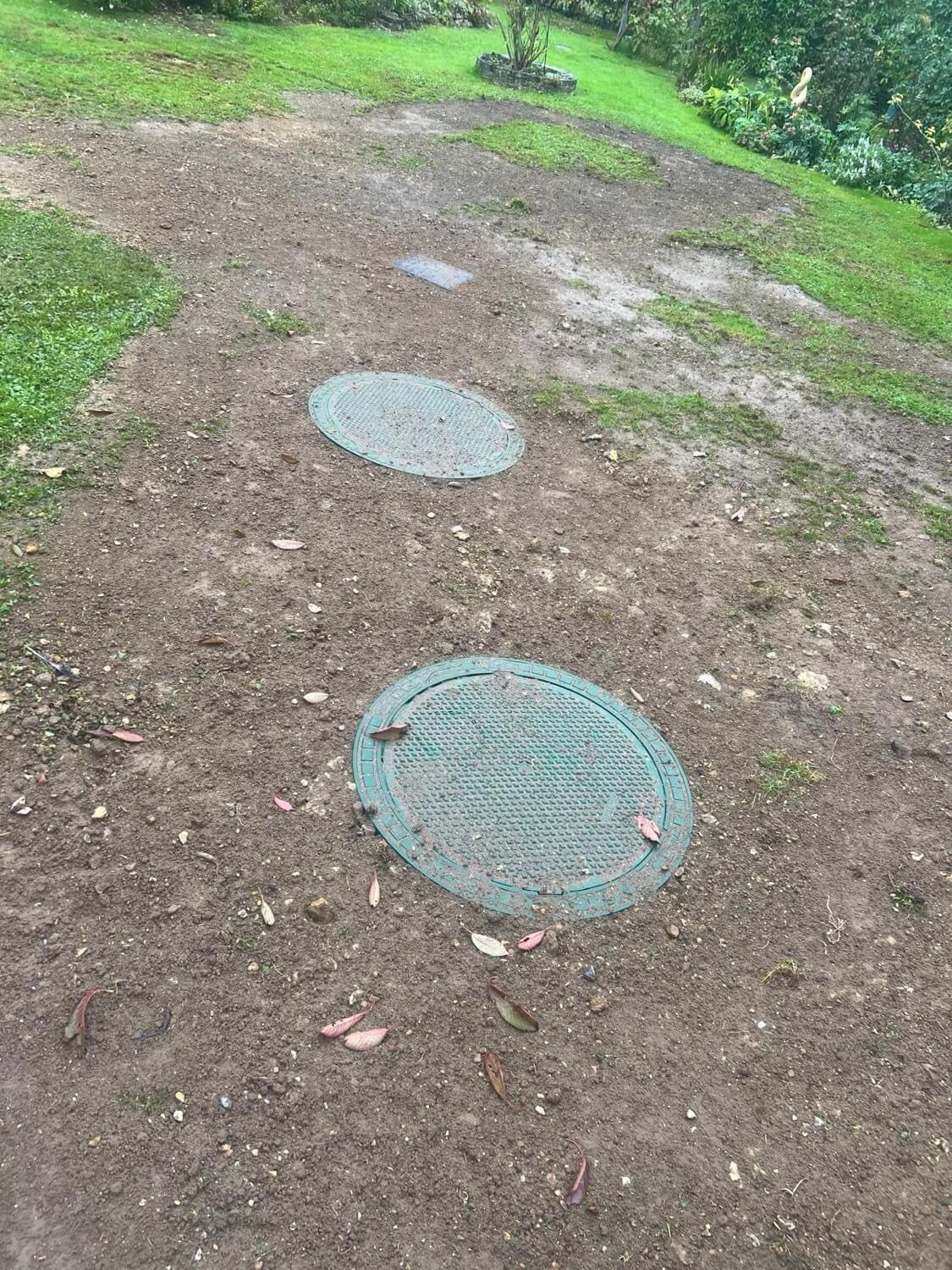
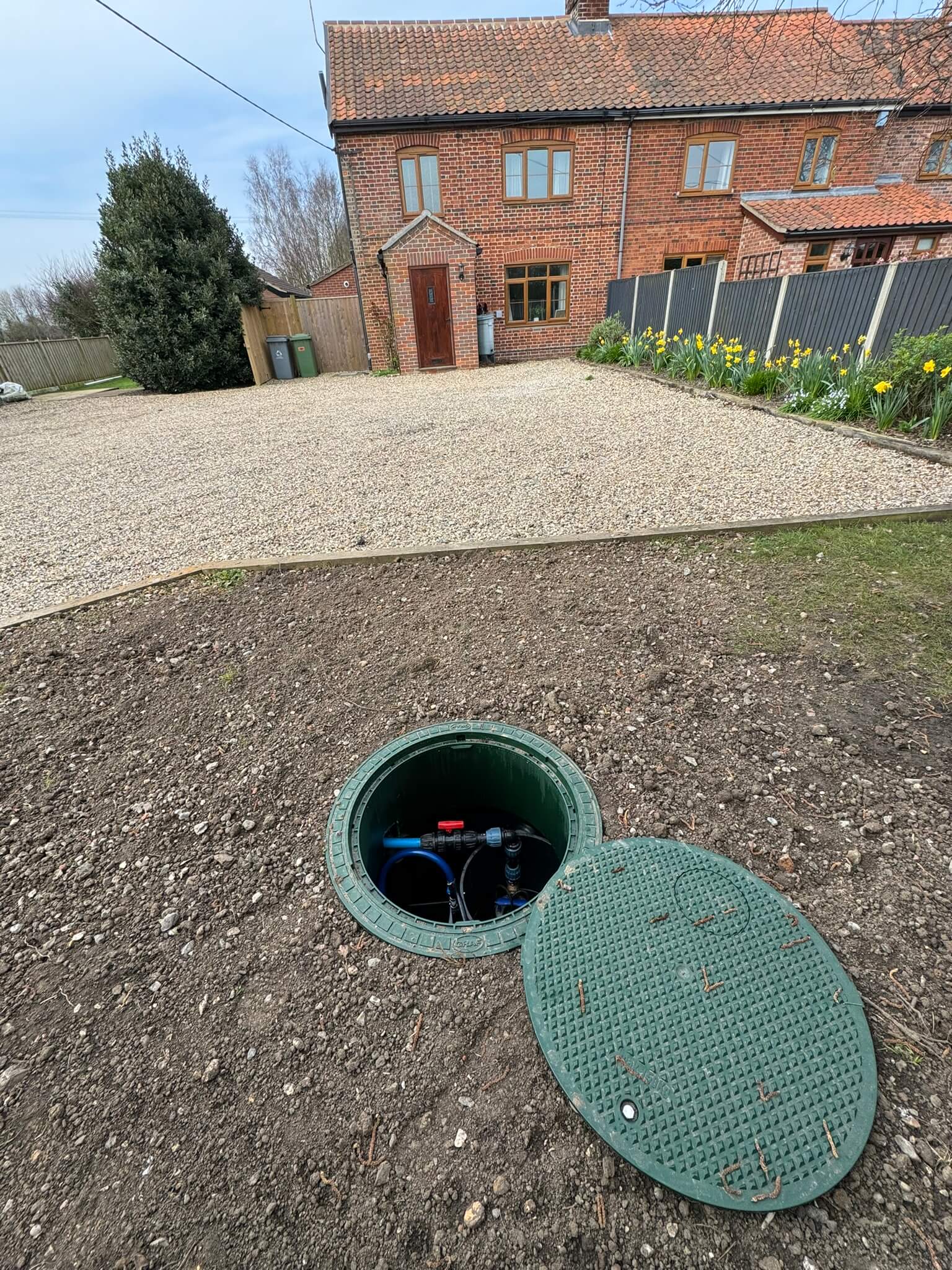
Apart from seeing 1 or possibly 2 new inspection covers, depending on your properties need, the only item that you will see above ground is the compressor housing which you can see in the attached photo. This can be positioned along a wall as in the photo, along a hedge or near an outbuilding subject to the surveyors approval.
You will also see below some examples of recent installations and how the area will be left. Please note that we do not re-landscape, lay turf or reseed your garden, It is left level and tidy for you to finish of as required.
Yes there are. Please take a look at the “Bin it – Don’t Flush it” document from Graf that outlines what you cannot flush into the system, this is extremely important and will have a major impact in how well your sewage treatment plant will work and how much maintenance it may need in the future if you mis-use it.
The two things that you need to take the most notice of is the type of cleaning products that you use and the level of fat and grease that may enter the system, usually from your kitchen. (see the following questions for more information).
As you will see on the list, it is essential that you cease to use any bleach based product with the new sewage treatment plant. Bleach will kill all bacteria and the new sewage treatment plant relies on bacteria for part of its processes. Therefore if you continue to use bleach this will have a major negative impact on its operation.
As part of our drive to clean up the environment we now offer the householder a 3 month, free supply of household cleaning products from a company call Bio-D – https://biod.co.uk/. This not only includes the products used for toilets but a whole range of products that you can use throughout the house. By using Bio-D it helps to remove all of the unnecessary chemicals from our cleaning products which eventually make their way through into the environment and our rivers. We also provide you with a 15% discount code for you to use when you place your first order directly with Bio-D. We have invested heavily in providing these free products for you to try and we just ask that you use them all during the first 3 months and then hopefully you will decide to continue to use them going forward.
As you will see on the “Bin it Don’t Flush it” document produced by Graf you should not allow food waste to enter the new sewage treatment plant. This includes fats and oils that you use whilst cooking (simply wipe pots and pans with a paper towel and dispose of this in your bin) and any food waste that should be placed in an appropriate food waste bin. The majority of food waste contains fat and this will have an adverse effect on the operation of the sewage treatment plant. Therefore scrape excess food from plates and pans into the bin before you put them in the dishwasher.
If it is a salt based water softener that discharges during a regeneration cycle, it is important that this discharge does not go into the new sewage treatment plant, but instead goes into its own small soakaway within the garden.
It is best to remember that the sewage treatment plant is yours and normally, no other households feed into it. Therefore if you do ignore the advice, you will only create problems for yourself going forward, including potential smells from the plant, increased servicing costs and blockages that you will need to deal with. You are also signing legal documentation to say that you will look after the plant going forward. Although we do cover the costs of looking after the plant in the first two years, if it is blatantly obvious that you are not looking after the plant as per the manufacturers recommendations, we do reserve the right to charge you for any call outs relating to the mis-use of the equipment.
For the majority of households much of the above will not come as any surprise and they already make the effort to look after their current septic tank and are considerate to the environment. If you don’t believe you will be able to make those changes then this scheme, which is primarily a environmentally focused scheme, is not for you and we would encourage you to find a suitable solution that you were happy with.
Home owners who live within the river catchment area of the scheme and within the relevant district council boundary are potentially eligible for the scheme. Please take a look at the two maps and it will show you the catchment area.
Kent – The blue shaded area on the Kent map is the catchment area – the darker shaded areas within the blue area indicates that you should have mains sewers available to connect to, although this doesn’t necessarily preclude you from the scheme.
Norfolk – The areas shaded blue, pink and beige are the catchment areas
If you are on the border or it is unclear as to if you are within catchment then feel free to either register and we will then check or give us a call on 01328 854549.
Please note that whilst it may be disappointing if you are outside of catchment, sometime only by a few meters, these boundaries are set in stone and we have no control over them. We can only advise you if you are within or outside of catchment for the purposes of this scheme.
Please be aware that where you live is only the first step in confirming that your property is eligible for the scheme. There are a number of other checks that we will need to carry out to confirm your full eligibility, including sites surveys, desktop surveys and legal checks.
Let me first of all explain the difference between a cesspit/cesspool and a septic tank, as this is not always understood correctly. A cesspit or a cesspool is a sealed container in the ground with no outlet on it, therefore as soon as it is full, both the liquids and the solids have to be removed. A septic tank has an outlet and therefore once the solids and the liquids have been separated, the liquids gradually seep away, normally into some for of drainage field or soakaway, this means that a septic tank needs emptying far less often than a cesspool or septic tank.
Because a cesspool or cesspit is not contaminating the local area (as it has no outlet) then unfortunately it cannot be replaced under the scheme.
If you are unsure and you do not have any evidence to suggest that it is a cesspit/cesspool and you do not empty the tank more than, say once per year, then register it as a septic tank and discuss it further with our surveyor when he comes to site.
The majority of properties do not need a permit, either for their existing septic tank or the new sewage treatment plant. However there are times when a permit is needed and you may have to ensure this is in place prior to us starting any work. An example of this is if you currently rely on a borehole for the supply of drinking water and this borehole is within 50m of the discharge point of your existing septic tank. Another is if you live is a special protection zone or a SSSI.
Sometimes we will make your aware during our desktop studies that your property falls within one of these areas, however ultimately it is up to the homeowner to ensure that they are operating within the law. If you have any doubts then please feel free to call us to discuss it further. Any permits that you do require, you would have to obtain from the Environment Agency.
The scheme, in the main, only covers residential properties and therefore businesses, villages hall, church halls and community buildings cannot take advantage.
If you have a business that in some way incorporates residential overnight accommodation that is regularly used, for example a residential care home or hotel then please call us to discuss it further.
No. The scheme is open to anyone that meets the general criteria of living within the catchment area and having a property where the installation is possible.
The physical site survey, stage 1 is there to look at your existing set up and a number of other factors at your property that will determine if we can proceed with your installation.
Stage 2 also undertakes various desktop studies in relation to your property and if it qualifies under the scheme.
In some circumstances, unfortunately the property may therefore not be suitable and we will advise you of this after we have completed stage 2 (this is prior to you being fully committed and therefore you will not incur any costs if we cannot proceed).
If you have a mortgage or any other secured borrowing on your property then your lender will need to be party to some of the documents and approve the scheme.
We can provide you with a draft copy of the document that they will need to sign if you want to approach them first to obtain their agreement in principle, otherwise we will send the paperwork to them on your behalf when the time comes.
If they don’t agree to sign the paperwork then we cannot proceed. To date we have only had one equity release lender called “More 2 Life” decline to sign the paperwork, all other lenders have signed to allow the scheme to proceed.
Some lenders do ask you as the homeowner to engage your own solicitor to answer some of their questions. If this happens then any cost of this would be between your lender, your solicitor and you, it is not something that the scheme will cover. If you do not have a solicitor that can help you with that, then we may be able to suggest one. In our experience the cost of this is circa £500+vat, but again this is between you and your own solicitor, we will not ask you for any payment.
From our past experience, in having now installed circa 200 tanks under the scheme and having dealt with many lenders, those that want the homeowner to use an external solicitor tend to be Natwest, Santander, Nationwide and TSB.
Please also see the FAQ under “costs” in regard to potential third party costs.
We will consider the results of each survey on its own merits.
During the survey the surveyor will need to walk the route, including any 3rd party land so please obtain permission for this to happen in time for the survey. If we cannot do this during the survey then we will have to decline the application.
In order for the installation to proceed the 3rd party landowner will also need to sign an access contract with you and ourselves to give us the permissions that we need during the installation. If they are not willing to sign our standard 3rd party access contract then we will not be able to proceed. Therefore we recommend that you discuss this fully with your neighbour in the very early stages of the process.
We will leave any 3rd party land in the same way as we would leave your own back garden, ie tidy and level. This does not include hand raking, or the reinstatement of any fences, hedges or any other item/structure that you or we have had to remove to allow the installation to proceed. If any additional work is requested by the owner of the 3rd party land then this is between the homeowner and the 3rd party land owner, we will not take on that additional work.
There are 2 main factors involved when it comes to how long you will need to wait for the installation to take place
1) Generally, we carry out these installations as a village/community project (see the FAQ’s entitled “Village / Community Installations”) and we would want to see that a reasonable number of households from your area register their interest before carrying out surveys in the area.
2) We are also led by the local planning authorities as to when they need us to carry out work in specific areas.
Because of these 2 factors, we may not be able to give you a timescale as to when the installation may take place. All you can do at this stage is to register your interest and then we will contact you when we are able to move forward.
Once we have completed stages 1 and 2 of the process and you have agreed to proceed to stage 3, there will be a contract to sign which will then give us up to 2 years to complete the installation.
Please be assured however that as long as there is call for installations to take place in your area from your local authority then we will want to arrange for your new sewage treatment plant to be installed as quickly as we can.
You will get an automated response to confirm your registration. Once we have a number of home owners registered within your immediate area we will then arrange for a surveyor to visit the area and asses the viability of your property.
We do prioritise areas based on the number of registrations we have. Given that the scheme is for the benefit of the whole community/village by cleaning up rivers, ditches and waterways we do encourage everyone to share details of the scheme with their neighbours. You will be sent a flyer that you can share with your neighbours to encourage them to register.
We are likely to be at your property between 2 and 5 working days, however this can vary depending on the complexity of each installation.
The average price to change a septic tank to a sewage treatment plant is in the region of £15,000. Therefore it would be wise to upgrade now, while the scheme is available, than to wait until such a point where you are forced to do it, the scheme may have stopped and you would have to pay for this yourself.
Absolutely, up until now the majority of our business are those homeowners that have a septic tank, they endeavour to try and sell their property and it is highlighted by the surveyor that either the existing system does not meet current requirements or that it is coming to the end of its life and will need changing soon. In our experience this then either causes the sale to fall through (as the lender is not willing to provide a mortgage on the property), the timescales on moving are dramatically increased because a new sewage treatment plant has to be installed or the buyer demands a large discount to cover the costs once they have moved in.
Therefore our advice is to have it done now and avoid problems further down the line.
Please make it clear to us if you are in the process of selling your house or you intend to start the process prior to the installation being completed as this will effect various aspects of the preparation.
At the present time the scheme is focussed on replacing only Septic Tanks. You are welcome to register your sewage treatment plant and if at some point in the future this is something we can look at then we will be able to contact you at that point.
We would like to make it clear that this is not a “pot of money” that homeowners are “entitled” to. We have spent a significant amount of time, effort and our own money in building this scheme with the approval of the various public bodies. We see this as a scheme that will help out everyone within the designated catchment areas to clean up our countryside and our rivers and therefore we are looking to work with communities to get these upgrades in place.
You will be required to cooperate with us throughout the process, answer any questions that we may have and provide any paperwork that is required to be able to progress the scheme. When we get to the legal stage we sometimes find issues or problems with the homeowners title at Land Registry and if this is the case you may well need to liaise with your own solicitor/Land Registry in order to rectify these issues before we can proceed further.
So whilst you are not in essence having to pay for the installation, you will still need to put some effort into liaising with us and other parties to allow it to happen.
Let me first of all explain the difference between a cesspit/cesspool and a septic tank, as this is not always understood correctly. A cesspit or a cesspool is a sealed container in the ground with no outlet on it, therefore as soon as it is full, both the liquids and the solids have to be removed. A septic tank has an outlet and therefore once the solids and the liquids have been separated, the liquids gradually seep away, normally into some for of drainage field or soakaway, this means that a septic tank needs emptying far less often than a cesspool or septic tank.
Because a cesspool or cesspit is not contaminating the local area (as it has no outlet) then unfortunately it cannot be replaced under the scheme.
If you are unsure and you do not have any evidence to suggest that it is a cesspit/cesspool and you do not empty the tank more than, say once per year, then register it as a septic tank and discuss it further with our surveyor when he comes to site.
The majority of properties that we work at do not have access to a ditch. In those circumstances we would look at the alternative of installing a new field drain at the property to deal with the treated water. The surveyor will look at these options during his visit.
In reality it is being paid for by everyone that is buying a property within the nutrient neutrality areas. Within the price of that house a very small proportion will be going to fund this scheme. We see that as being a really important reason that those who are able to take advantage of the scheme do so while it is still available and then in that way that money stays within our communities.
We will work with you and you can discuss the location of the tank during the initial site survey (Stage 1), however please do keep in mind that we do have to take many factors into consideration when determining the location of the various equipment, including but not limited to location of existing septic tank, building regulations, installation guidelines, accessibility to the site and the costs of the installation.
Whilst the scheme will cover the usual costs involved in installing the tank, if you insist on a specific location that increases our costs beyond what the scheme will cover we may need to decline to proceed.
Please keep this in mind when you meet with the surveyor.
For the safety of the animals and also of our staff any area that is used for the sewage treatment plant, kiosk or drainage field should not be used to keep animals on in the future. If you want to do this then the area would need to be fenced off with a suitable pedestrian access gate into it so that our team can maintain and service the plant in safety and that there is no risk of damage to the equipment.
We don’t hide the fact that a substantial job such as installing a sewage treatment plant does not come without cost. However the important bit for you is that you, as the homeowner does not have to pay.
The £1000 monitoring fee is to help the local authorities cover the cost in monitoring the unilateral undertaking, to ensure that it is implemented and adhered to going forward. Although the unilateral undertaking says that it is the homeowner that pays this fee, it is actually covered by us and this is confirmed in the briefing letter from the local authority. If you have not already seen that letter then please ask and we can supply you with a copy.
All of the work, including the site survey is covered under the costs of the scheme and we will not ask you for any payment.
Here are a couple of scenarios that we have come up against –
If you have a problem with your existing foul drains that you know is causing you a problem and it is situated before the inspection chamber prior to the existing septic tank, ie pipework that we would not normally touch or replace, then we would normally ask you to resolve the problem with another contractor before we start work.
Another common issue is that rainwater from your gutters is currently going through your existing septic tank. In these circumstances it would be down to you to divert this water away from the septic tank and into a proper soakaway prior to us being able to start work.
Please be aware that if you have confirmed something with us, for example, that the existing storm water from your roofs does not go into the existing septic tank and then during the installation it is found that it does indeed go into the septic tank, we are not obliged to take on additional work to correct these issues. Even if we do offer to help you find a solution and maybe even implement that solution, this may come at an additional cost to you that we will discuss with you. In these circumstances if an immediate solution cannot be agreed upon then we will continue with the installation of the new sewage treatment plant and then you would need to take immediate action to put any further solution in place, ie arrange for an alternative contractor to install the correct soakaways.
The other would be if we have caried out what we refer to as stage 1 and stage 2 of the process, we confirmed with you that we were happy that the installation was possible and you then confirmed in writing that you wanted to proceed. If after this point you chose to cancel the contract then you would be liable for the £3000+vat in costs that we had incurred up until that point. As long as you have the plant installed then there is nothing to pay.
The scheme will not cover any costs associated with third parties such as a mortgage companies or any costs associated with crossing or using a neighbours land to allow the installation to proceed.
If it is found during the survey that your consumer unit ( fuse board ) is also not up to modern standards,preventing us from connecting the new sewage treatment plant, then you may also incur some 3rd party costs in correcting this problem before we can proceed.
If you have a mortgage or any other secured borrowing on your property then your lender will need to be party to some of the documents and approve the scheme.
We can provide you with a draft copy of the document that they will need to sign if you want to approach them first to obtain their agreement in principle, otherwise we will send the paperwork to them on your behalf when the time comes.
If they don’t agree to sign the paperwork then we cannot proceed. To date we have only had one equity release lender called “More 2 Life” decline to sign the paperwork, all other lenders have signed to allow the scheme to proceed.
Some lenders do ask you as the homeowner to engage your own solicitor to answer some of their questions. If this happens then any cost of this would be between your lender, your solicitor and you, it is not something that the scheme will cover. If you do not have a solicitor that can help you with that, then we may be able to suggest one. In our experience the cost of this is circa £500+vat, but again this is between you and your own solicitor, we will not ask you for any payment.
From our past experience, in having now installed circa 200 tanks under the scheme and having dealt with many lenders, those that want the homeowner to use an external solicitor tend to be Natwest, Santander, Nationwide and TSB.
There are 3 main costs involved in having a sewage treatment plant –
1) The plant does require an electricity supply, for an average property of up to 5 bedroom this would use approx. 1.08kwh per day. You would need to check you daytime and nighttime supply rate with your provider but on an average of 25p per kwh then it would equate to approx. £98per year.
2) You will need to empty the new tank on average every 2 – 3 years. You can continue to use your existing contractor to do this.
3) Under the General Binding Rules (The law that covers Septic Tanks and Sewage Treatment Plants) you do have to have the new plant inspected each year, which currently costs £150+vat. The contract allows this to potentially rise with inflation each year
We cover the cost of the annual service for the initial 2 years and then you will pay it as from month 24 each year.
We may need to use electricity on site and we will certainly need to use your water supply. An integral part of the installation process is to fill the new tanks with water as the installation progresses to prevent them from “popping” out of the ground until the concrete is set. This will mean that we will ask you to turn on your taps for an extended period of time. Any of these costs are borne by the home owner or tenant.
To put it in perspective a medium sized tank that serves a 5 bedroomed property will hold around 2880 litres of water at its normal working level which would cost around circa £7.78 to fill.
Yes you can but there are certain things to keep in mind
1) The scheme works on a like for like basis, if you currently have a shared tank then the new sewage treatment plant will also be shared
2) The tank will remain in the same garden that it is currently in, ie we cannot move the tank’s position from one property to another.
3) The legal documents will include details of all parties that feed into the tank that is being changed. Your personal details, such as name, address and also if you have a mortgage on the property will be visible by all parties (Details such as the amount of your mortgage are not visible). If you do not agree to this then please do not register as there is no alternative.
Each household feeding into the tank needs to make a separate registration, answering the questions accordingly. This covers us from a data protection perspective and also confirms that each household has reviewed these frequently asked questions and understands the scheme.
We cannot proceed with any of the properties until all the homeowners that feed into that same existing tank have registered.
No – all homeowners that share the tank need to be involved and agree to the contract and unilateral undertaking otherwise none of the homeowners of the shared tank can benefit.
Please read through the section that deals with the 3 stages of the process, so that you understand those stages. The additional risk is born by the owner of the existing tank, as this is usually where the new tank will go.
We would recommend that you speak to us after you have registered to discuss your particular arrangement as shared tanks are usually more complicated.
We would suggest that you liaise with any neighbours that share your tank from the outset so that you all fully understand the scheme and the risks. You could consider having some form of agreement between you to cover any eventuality, but this would be between yourselves and not us. Our main contract for the installation is with the homeowner where the tank is installed.
There are many different reasons why upgrading a number of properties within a village can be advantageous to both us and you at the same time, these include
1) It keeps the amount of vehicle movements in and out of the village to a minimum as we can very often set up a small compound to keep materials and equipment in.
2) It keeps our costs down
3) It means that everyone in the village is given the opportunity to partake in the scheme as there are not always sufficient numbers for us to make multiple visits in the smaller locations.
4) The timescales over which we need to be in the village are much shorter
5) You will often find that your installation will be carried out much quicker if we have more to do.
In our experience there are some key steps in a village successfully implementing the scheme
1) Having one or two key co-ordinators to spear head the scheme ensures a structured approach – no technical knowledge or ability is needed !!
2) Decide on a location in the village where a meeting can be organised – as long as the date is discussed with us and we are available we are happy to come along and run the meeting and answer any questions. (In our experience a parish council meeting is not the ideal forum for this)
3) We can then print you some flyers that include the time, date and location of the meeting which you can distribute to all properties in the village or parish.
4) Meeting takes place, we can give a short presentation and everyone is given the opportunity to ask questions – we find people are more likely to ask questions in this sort of environment, however there will also be time at the end where they can approach us about a question that might only apply to their property.
5) This then moves on to the 3 stages as explained elsewhere.
There are 3 main stages to the scheme which I will outline below and you will see these referred to as you progress. Following registration, we will retain your details on file and when we have sufficient interest from properties in your area then we will make contact with you to start the process
You will be asked to sign an engagement letter which will be sent to you digitally by a company called Docu-sign. The letter will outline the 3 stages to you and what will happen at each of these stages.
Please be aware that if you do not sign the engagement letter then we cannot carry out the survey and the appointment you may have arranged will be cancelled.
We have to make you aware of all of the key details about the scheme and the different stages at the outset and therefore we have to have your signature to acknowledge that you have read and understood the information presented – you are free to call us if there is any aspect that you don’t understand. The initial survey is part of the overall process and you are asking us to carry out that survey to see if you can proceed further with the septic tank upgrade. See the attached copy of the letter you will be asked to sign.
You can simply walk away with no cost to you, just let us know. After the survey has been carried out we can choose not to proceed with the installation if there are factors that prevent us from proceeding and likewise you can too.
Yes, once we are happy that we can proceed with the installation we will send you another Docu-sign letter which explains that this is the point at which you are committing yourself to proceed with the installation. If you decide not to sign that form, after asking any further questions that you are unsure of, then you will not be committed and there will be no costs to pay.
If you sign the form to commit yourself and then you withdraw from the process, then this is when we will invoice you for the £3000+vat.
We will arrange for a surveyor to visit your home to undertake the survey (these usually last between 30-60 minutes) to ensure that the property is suitable for the scheme. This is an extremely important part of the process and we would encourage the home owner to be available for as long as the surveyor needs during the visit.
The surveyor will need to decide where the new plant and associated equipment can be positioned, and he will want to check with you that the position is acceptable. There are multiple factors taken into account when deciding on the location including building regulations.
He will also need sight of your consumer unit/fuseboard within your property to ensure it meets current regulations (He will need to take a photo of this consumer unit for the survey).
The surveyor has a limited amount of time to carry out the survey and will not be able to answer any questions about the scheme itself or the type of equipment being installed, these should either be answered by calling us in the office on 01328 854549 or referring to the frequently asked questions.
During the visit he will be completing a digital form and this has to be completed in a set order to ensure that we capture all of the details that we need. Please do not take offence if he cannot engage with you at certain points or asks you to wait until later in the process to answer any questions that you may have. Please remember that he is there to carry out a survey on our behalf and our office staff will have more than sufficient time to discuss any aspect of the installation with you once the survey has been assessed in the office.
We do welcome your input as to where the plant and equipment might be located, the access route to the property and any other stipulations that you may have, such as where we might be allowed to store materials or park equipment etc etc, we appreciate that it is your property, however please do keep in mind that if you insist on something that does not work for us or increases the cost of the installation beyond what we can accommodate then we are likely to decline your application.
Examples of this may be
You insist that we take a much longer route to get to the site of the installation than is necessary
You insist that the new sewage treatment plant is placed somewhere different to where the existing septic tank is situated
You insist that we carry out additional work that is not normally included within the installation.
This involves carrying our various desktop studies by our civil engineers that are required by Natural England and the relevant authorities. This will prove to them that your property is eligible for the scheme
Following the completion of stage 2, we will then contact you to confirm that we are able to proceed with the installation. At this point we can answer any further questions that you may have.
We will then email you a further document via Docu-sign to confirm that you want to proceed. It is really important to note that if you sign to say that you wish to proceed with the scheme and then you decide that you want to withdraw, then you will be liable for our legal fees of £3000+vat.
To Confirm, however, as long as you have the new sewage treatment plant installed there is no cost to you.
Stage 3 At this point we will pass your file over to our lawyers to draw up the relevant paperwork for you to sign. Once this is available then you will need to come into our office to sign that paperwork.
If you have a mortgage over the property then your lender will also need to sign the paperwork to agree to the scheme. We will send this off to them on your behalf, however you may need to liaise with them if they have any questions.
Once the paperwork is all in place we will come back to you and as soon as we can we will give you an idea on the timescales for the installation.
You first of all need to complete the online registration form, once this has been completed and we are ready to carry out your surveys in your area then one of our team members will give you a call to arrange the survey. We cannot arrange a survey if you haven’t or you are unwilling to complete the online form.
Please read through the attached letter which will be sent to you to confirm the appointment.
Yes, this is a very important part of the process and it is essential that the homeowner is present, critical decisions will be made about the installation and its position during the visit.
Please call the office on 01328 854549 as soon as you are aware, we will do our best to re-arrange the survey for another time, however please note that this is not always possible.
The surveyor will only ask you questions that are relevant to our survey and we need you to give full and frank responses to allow us to make the many decisions that are part of the process. If you choose not to answer those questions then it is likely that we will decline to proceed with your installation.
Unfortuantely if you are not prepared to be onsite then we are not prepared to carry out the survey, this is a very important part of the process and being onsite is not optional.
As a general rule of tumb, we will want to site the new sewage treatment plant as close as possible to the existing septic tank. Therefore there will need to be sufficient room in that area to install a new sewage treatment plant (the hole would be circa 3mx2m) and if you do not have a watercourse or ditch to discharge to then we would also need to install a new drainage field which would take up are area of approx 8m x 8m, depending on the size of the property and the results of the percolation tests.
Sometimes we can place the new sewage treatment plant in a driveway, however this is at our discretion and only if there is nowhere else for it to go. I’m afraid that, not wanting to disturb your lawn or flower bed is not a reason why the new sewage treatment plant can go in the driveway. Under current building regulations a driveway is not a suitable location for a drainage field and therefore that is not an option.
We will need clear access to the installation site with a minimum width of 2.5m and a minimum height of 3m. If this is not achievable it is unlikely that we can proceed. If it is achievable by you removing overhead restrictions such as,tree branches or widening the acess by taking down, walls, fences, hedges etc then please let the surveyor know that you are happy to do this,any additional work required would be your repsonsibility.
Due to the added complications that this would create we would not wish to proceed on that basis.
This could be a solution, you would need to discuss this with your neighbour prior to the survey, as the surveyor would need to check the route and take photos along that route. Ideally your neighbour would also be signing up to the scheme too and therefore the installations can be done at the same time. If we are crossing any 3rd party land to get to your garden, then the owner of that land would need to sign our standard access contract prior to any work starting.
It is important that anything that we have highlighted to you at the survey stage that needs to be done, is completed at least a week prior to installation. This may include, but is not limited to the removal of plants, hedging and the trimming of trees. The diverting of any storm water that currently goes into the current septic tank into proper soakaways. Any repair work that is necessary to the rest of the foul drainage system in order that the new plant can operate correctly.
Our team may start to arrive as from 7am and therefore it is important that all vehicles are moved from the driveway and access routes prior to this time. A mains water supply will need to be available to the installations team while they are onsite, if there are multiple properties feeding into the tank then we may need to take a supply from each property and the cost of any water used is the responsibility of the home owner.
Our electrician will also need access to the inside of the property during the installation.
You will not lose your water supply during the installation. We do ask you to keep to a minimum the amount of waste water you put into the foul drainage for around 48 hours whilst we install your new plant. i.e avoid loads of laundry washing and maybe have a short shower instead of a bath. Our engineers on site can let you know once everything is back to normal.
This will be discussed with you prior to the installation, however generally if the septic tank is currently in the rear of the property, then this is where the new sewage treatment plant will be installed. As a general rule of thumb we would need to be able to drive machinery the size of a small car to that area.
It should be kept in mind that we will have various vehicles and deliveries onsite and arriving throughout the installation. We do therefore ask that any vehicles that are normally parked on the driveway are maybe parked elsewhere during the period we are there. It is also essential that children and pets are accompanied at all times whilst we are onsite for their safety and ours.
We will usually arrange to have your old septic tank emptied to coincide with when we start work. Subject to suitable access to your existing septic tank and assuming it is close to the installation position of the new sewage treatment plant, the old septic tank will be de-commissioned and you will no longer see it once the work is complete, ie the area will just become part of your garden.
This is subject to the site survey and other factors during the installation process, so please be aware that this is subject to our best endeavours.
We may need to use electricity on site and we will certainly need to use your water supply. An integral part of the installation process is to fill the new tanks with water as the installation progresses to prevent them from “popping” out of the ground until the concrete is set. This will mean that we will ask you to turn on your taps for an extended period of time. Any of these costs are borne by the home owner or tenant.
To put it in perspective a medium sized tank that serves a 5 bedroomed property will hold around 4800 litres of water which would cost around £13 to completely fill.
We make it very clear to everyone that the area around the installation will be left tidy and flat, assuming of course that it was when we arrived ! We are not landscapers and the scheme does not cover the costs of relandscaping, seeding, turfing or replacing any plants, hedges or fences that needed to be removed for the installation to proceed. Please therefore be prepared that some effort by yourselves may be necessary to return your garden to how you like it.
As part of the installation, we will provide you with a sign off certificate from Building Control to confirm that the drainage aspect of the installation has been carried out to the required standards. In order to send you this certificate we do need your signature on a building control compliance form as soon as the drainage aspect of the installation has been completed. This will be sent to you electronically via Docu-Sign.
You should keep the final certificate safely with other important documents about your property.
No, we need to ensure that our service engineers can access the area where the new sewage treatment plant is located at any time in case of breakdown and servicing. We always try to let you know when we are carrying out a scheduled visit, however there may be times when we need to service the equipment at short notice and therefore the inspection lids should not be covered with shingle, matting, flower pots etc, as this will make it difficult to identify their location and access the equipment.
If we have arranged a visit with you and we find that we are unable to access the equipment when we arrive then we do reserve the right to still charge you for that visit.
The new sewage treatment plant will require a service each year in line with the General Binding Rules and the manufacturers recommendations to ensure that the plant is working correctly. During this visit we will also advise you if the plant needs to be de-sludged, which on average is every 2-3 years.
During the first year we will also carry out at least 3 additional visits to the plant to carry out water tests.
Yes, in line with all sewage treatment plants, the plant will need to be emptied however The Graf system works extremely efficiently and reduces the amount of sludge that builds up within the tank. We find an average interval of around 2-3 years between emptying. Circa 200mm of sludge should be left in the new plant at all times even at the point of emptying.