

As the UK continues to address the urgent need for new housing while protecting its waterways, Nutrient Neutrality has become the defining planning constraint in many of the country’s most ecologically sensitive river catchments. The River Axe is one of them, a Special Area of Conservation that has been in unfavourable condition for over forty years, and where the route back to ecological health depends on coordinated action across agriculture, water companies, landowners and the wastewater systems that sit on private property.
For developers, planning consultants and local authorities operating in the Axe catchment, the regulatory picture is now well-established. Natural England issued nutrient neutrality advice to East Devon District Council, Dorset, Cornwall and Somerset Councils about phosphates in the River Axe in March 2022. On 25 January 2024, the Secretary of State formally designated the River Axe as a nutrient-sensitive catchment for phosphorus. New development in the catchment must demonstrate that it adds no further nutrient load to a river that is already significantly over its targets. For the National Rivers Consortium (NRC), the question is no longer whether mitigation is required, but how it is delivered, secured and verified at scale.
This article, the first in a five-part series looking at catchments NRC operates in, sets out what is being protected on the Axe, why nutrient pollution poses such a particular threat to the river’s ecological features, and how the credit work being delivered through Conservation Covenants contributes to the wider effort to return the catchment to favourable condition.
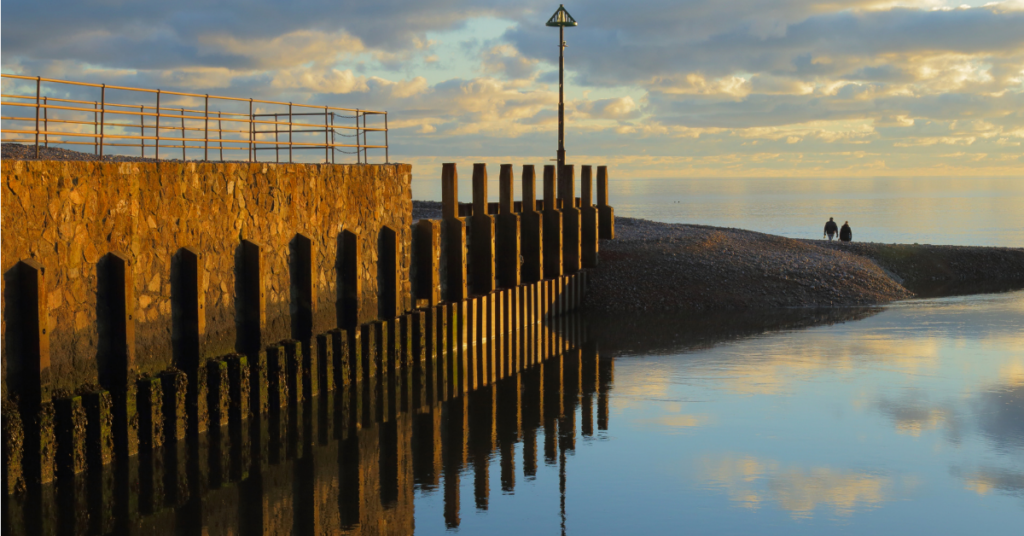
Wooden groyne at the River Axe estuary
What the River Axe is
The River Axe drains a catchment of around 307 square kilometres. The river runs through a mix of geology, sandstones and limestones across the lower catchment, giving rise to calcareous waters. The Axe isn’t a chalk stream, but it shares features that make chalk rivers ecologically valuable: relatively stable flows, clean gravels in the right stretches, and a mosaic of habitats from fast-running riffles to quieter pools.
The catchment is largely agricultural. Pasture and arable land dominate, with smaller pockets of woodland along the steeper valley sides. Several smaller tributaries feed the main river: the Coly, and the Blackwater, and most are part of the SAC designation.
Why it’s protected
The Axe was designated a Special Area of Conservation under the Habitats Directive, which gives it the highest level of protection available under UK law. The primary reason for the designation is the river’s plant community: the Axe is a south-western example of a particular type of running-water habitat. The river supports a distinctive community of water crowfoot and water-starwort, including the locally significant short-leaved water-starwort Callitriche truncata. That plant community is the primary feature the designation protects.
Alongside the habitat designation, three fish species are listed as qualifying features:
Sea lamprey (Petromyzon marinus), a primitive jawless fish that spends most of its life at sea and returns to spawn in rivers like the Axe.
Brook lamprey (Lampetra planeri), a smaller, freshwater-resident lamprey that spends years as a larva buried in silt before emerging to spawn.
Bullhead (Cottus gobio), a small, bottom-dwelling fish that needs clean gravel and stones, and good oxygen levels in the water.
There’s more in the catchment than the SAC citation captures. Atlantic salmon and sea trout run the Axe; salmon populations declined through the 1970s and 1980s to the point where no salmon were recorded in the late 1980s and early 1990s, and have only partly recovered through hatchery-supported rehabilitation work that began in 1988. Otters are present, as are kingfishers, dippers, and, in some tributaries, water voles. But the SAC sits on the plant community and the three fish species above, which shape the regulatory framework for development.

Atlantic Salmon (Salmo salar)
What’s at stake from nutrient pollution
Phosphorus and nitrogen are nutrients. In the right amounts, they support life. In excess, they drive what ecologists call eutrophication, algae blooms, oxygen drops at night as the algae respire, and plants and invertebrates that depend on clear water die back. The river’s ecosystem unravels from the bottom up.
The Axe has been in unfavourable condition for over 40 years. Natural England’s condition assessment in June 2024 stated that recent water quality measurements for the River Axe within the SAC show that phosphorus concentrations exceed the targets at all units. To meet the SAC standard, average phosphorus concentrations need to be reduced by at least 50%.
The sources of that excess phosphorus are well-understood and cumulative. Agricultural runoff is the largest single source. Discharges from sewage treatment works contribute. South West Water is required to upgrade the Kilmington, Tatworth, and Colyton wastewater treatment works to meet the Technically Achievable Limit before 1 April 2030. And then there are private wastewater systems, ageing septic tanks discharging to ground or to a watercourse, which contribute a meaningful share of the load and, individually, are hard to regulate or upgrade at scale.
For the water crowfoot community, the SAC was designated to protect against excess phosphorus, which is direct and damaging. Algae outcompete the rooted plants. Sediment smothers gravel beds. For a lamprey larva living buried in silt for three years, water quality isn’t an abstraction; it’s the medium it breathes in, feeds on, and develops in. For bullhead, it’s the difference between viable gravel habitat and a smothered riverbed.
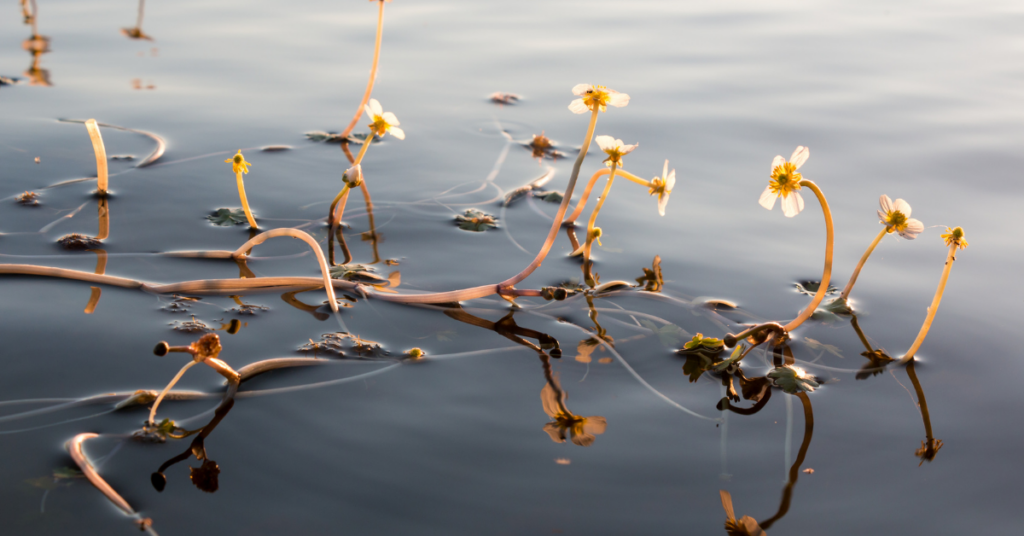
Water-Crowfoot flowers
This is why Natural England issued advice to East Devon District Council, Dorset, Cornwall and Somerset Councils in March 2022 on phosphates in the River Axe, requiring nutrient neutrality for new development in the catchment. The argument is straightforward: the river is already over capacity for the nutrients it can carry without ecological harm. Adding more, even from a single new development, makes that worse. So, new development has to be neutral; every kilogram of phosphorus a scheme adds has to be offset by an equivalent reduction elsewhere in the same catchment.
How NRC’s work contributes
NRC’s mechanism in the Axe catchment is the same as the mechanism we use everywhere we operate: replace an existing, underperforming private wastewater system with a Graf One2Clean package treatment plant, secure the upgrade legally through a Conservation Covenant under the Environment Act 2021, verify the nutrient reduction, and issue a credit equivalent to the measured savings.
An old sewage treatment plant or watercourse discharging to the ground or to a soakaway is a significant ongoing source of phosphorus to the catchment. A modern, properly sized, well-installed package treatment plant reduces that load substantially. The difference between the two, measured, verified, and held in place by the Conservation Covenant for the agreed term, is what generates the credit.
Every upgrade in the Axe catchment removes a slug of phosphorus load that would otherwise have continued for decades. The credit generated by the upgrade can then be used to offset a new housing scheme elsewhere in the catchment, allowing it to proceed with planning without adding to the river’s nutrient burden.
Importantly, NRC’s contribution sits alongside several other strands of catchment recovery: the South West Water treatment works upgrades referenced above, the £4.09 million awarded to East Devon District Council under Round 2 of the Government’s Local Nutrient Mitigation Fund, announced in the October 2024 Budget, together with £192,494 in capacity support funding and a further £100,000 through the Nutrient Support Fund, and the agricultural and habitat work being delivered through the Upper Axe Landscape Recovery Project. No single mechanism will get the river back to a favourable condition. The point is that they don’t have to act alone.
What this means for developers in the catchment
If you’re developing overnight accommodation in the Axe SAC catchment, the planning constraint applies. Your scheme needs to demonstrate nutrient neutrality, and that obligation sits with the developer. East Devon District Council, Dorset, Cornwall and Somerset Councils act as the lead authority on planning issues relating to nutrient pollution of the River Axe.
The route to neutrality varies. Some sites can minimise their nutrient budget through design, choice of foul drainage solution, surface water management, and so on. Most schemes, regardless of size, will need credits to offset the residual load.
NRC has credits available in the Axe catchment. They come with the full audit trail: independent verification of the underlying installation, ongoing telemetry monitoring, Conservation Covenant under the Environment Act 2021, securing the reduction for the agreed term, and Responsible Body sign-off from RSK Biocencus.
You can check indicative credit costs and availability on our Developer Portal without registering, or speak to our team if you’d prefer a direct conversation about your scheme.