

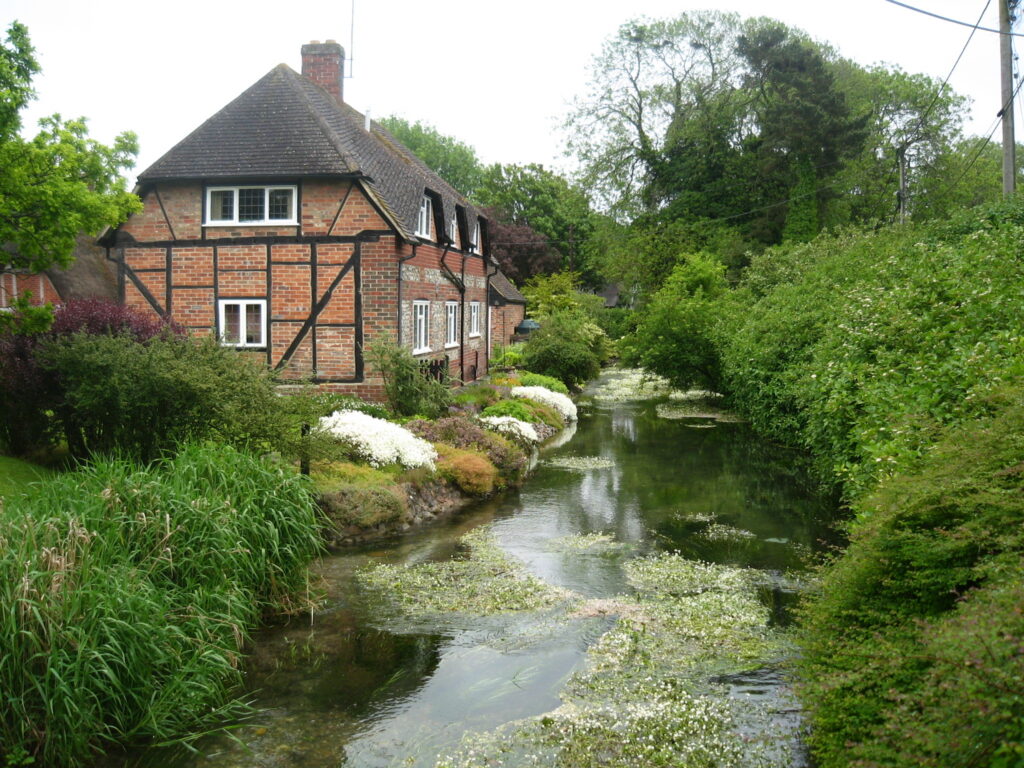
The River Lambourn originates from chalk springs in the woods above its namesake village and flows southeast for about 26 kilometres. It gathers the Winterbourne Stream before joining the Kennet at Newbury and, via the Kennet, the Thames. For much of its upper course, it is a winterbourne, flowing in winter and drying up in summer. It is one of the least-modified chalk streams in southern England, and chalk streams are among the rarest freshwater habitats on Earth. Only about 200 exist worldwide, with roughly 85% located in England.
What makes the Lambourn internationally significant
The River Lambourn is designated as a Special Area of Conservation, one of Europe’s protected sites of top ecological importance. This designation focuses on its habitat rather than a single species. The habitat is dominated by water-crowfoot, a white-flowered plant that oxygenates the water and provides shelter for invertebrates and fish. Its qualifying Annex II species include the bullhead, a small, bottom-dwelling fish that requires clean gravel and high water quality, and brook lamprey, which spawns in the same gravels. The site is also legally protected as a Site of Special Scientific Interest. Beyond official protections, it supports a typical chalk-stream ecosystem, including wild brown trout and mayflies, thriving in its clear, cool waters.
The Lambourn Valley is also known as the ‘Valley of the Racehorse’
The character of the Lambourn Valley is shaped by the underlying chalk. Rainwater seeps into the aquifer, filtering slowly and emerging clear, cool, and naturally low in nutrients. The chalk vein also gave rise to the valley’s reputation. The well-drained, springy turf of the downland made it an ideal training ground for racehorses, earning it the nickname ‘Valley of the Racehorse’ since the 18th century. After Newmarket, it is England’s second-largest racehorse training area, with numerous yards across its gallops.
The link to water is ancient. The village name is believed to mean the stream where lambs were washed, reflecting centuries of farming and trade along this watercourse. The river and local racing industry have grown from the same rich ground.
However, this dependence on pure water makes the river vulnerable. Since the habitat evolved with naturally nutrient-poor water, even small nutrient increases can disturb the balance.

Impact of phosphorus on a chalk stream
Chalk streams stay clear and plant-rich as long as nutrient levels remain low. Excess phosphorus, however, can cause algae blooms, oxygen depletion, and overgrowth of nutrient-tolerant plants, displacing the water-crowfoot the site aims to protect. In March 2022, Natural England reported that the River Lambourn SAC was in unfavourable condition because phosphorus levels exceeded targets along its length. The concern specifically involves phosphorus alone, rather than the combined effect of nitrogen and phosphorus often seen in other wetlands.
Nutrient Neutrality and new development in the catchment
Phosphorus enters the Lambourn from multiple sources: agriculture, existing development, and more. Nutrient neutrality targets the additional phosphorus introduced by new developments, primarily through wastewater. As more people move into the catchment, including new homes, holiday lets, care homes, or annexes, the phosphorus load in sewage increases.
In March 2022, Natural England told planning authorities that any new development adding phosphorus to the catchment must demonstrate nutrient neutrality before approval. The catchment mainly covers West Berkshire, extending into Oxfordshire and Wiltshire. To get permission, any new overnight accommodation must show it does not increase phosphorus levels in the river.
What NRC does in the Lambourn
Our process is simple: we identify properties with old or failing septic tanks and replace them at no cost with Graf One2Clean treatment systems, which are assembled and calibrated at our factory. This upgrade reduces environmental impact by preventing poorly treated effluent from seeping into water sources.
The Graf One2Clean unit helps lower phosphorus levels and improves water quality. Each system is monitored after installation, ensuring the reduction is measurable and verified. These reductions are converted into phosphorus credits, which developers can use to meet planning requirements. Since mitigation applies only where the pressure occurs, credits are generated and utilised within the Lambourn catchment. If you’re building within this area and face nutrient requirements, we can assist.