

The River Wensum rises near South Raynham in north-west Norfolk and flows east through Fakenham, North Elmham, Swanton Morley, Lyng and Lenwade, then on past Taverham and Costessey into Norwich. It leaves the city on the south-east side and joins the Yare. Its catchment covers around 650 square kilometres, and all of it sits on chalk.
That geology is interesting. Rain soaks into the chalk aquifer, filters slowly through it, and emerges at the springline clear, cool and naturally low in nutrients. Rivers fed this way are rare. Government estimates put around 85% of the world’s chalk streams in England, and the Wensum is one of the largest.
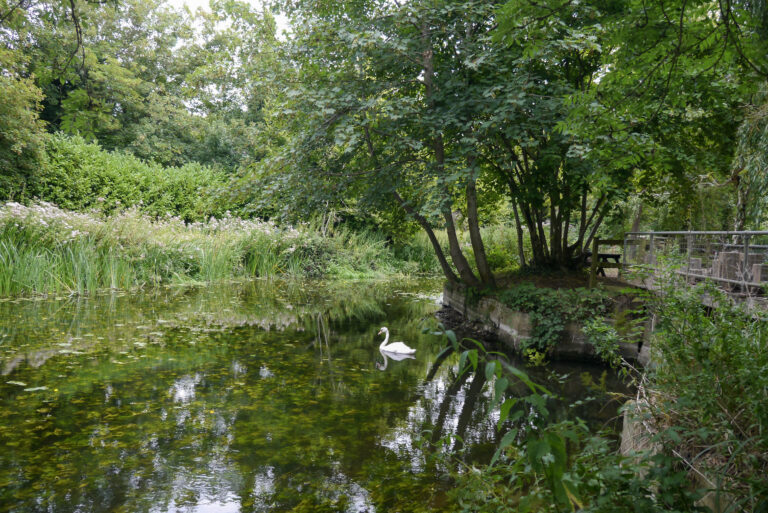
Why the Wensum is protected
The river is a Special Area of Conservation, and 71 kilometres of it are also a Site of Special Scientific Interest.
The designation protects a habitat rather than a single species. Water-crowfoot, the trailing white-flowered plant that oxygenates the water and gives fish and invertebrates cover, is the thing the site exists for. Four protected species qualify alongside it: white-clawed crayfish, Britain’s only native crayfish and an increasingly rare one, Desmoulin’s whorl snail, brook lamprey, and bullhead. All four want the same conditions: clean gravel, clear water, and low nutrients.
The mills that changed the river
The Wensum was a working river for centuries, and milling reshaped it. Natural England’s River Wensum Restoration Strategy counts fourteen mill structures still standing, from Sculthorpe and Fakenham in the upper reaches down through Bintry, Elsing and Lyng to Costessey and Hellesdon on the edge of Norwich.
They still hold the water back. Between Shereford and Hellesdon, the same strategy found that 67% of the river, some 45.7 kilometres, is sitting in backwater conditions rather than running freely over gravel. Slow water drops its sediment, and the numbers bear that out: annual maximum concentrations of suspended material have risen threefold since recording began in 1977. Silt settles on the spawning gravels that crayfish, lamprey and bullhead need.
It also changes how the river copes with nutrients. A chalk river in good physical shape flushes itself out. One held behind fourteen structures holds onto whatever reaches it for longer. Every river unit of the SSSI is currently in unfavourable condition, and the reasons given are always the same three: high phosphate, siltation, and physical modification.
What phosphorus does to a chalk river
Chalk rivers built their ecology around water that arrives clean and stays that way, so there is very little tolerance for enrichment anywhere in the system. Add phosphorus and algae take off, coating the gravel and the plant stems and cutting the light off from the riverbed. Water-crowfoot gets shaded out and coarser, nutrient-tolerant plants move in. Oxygen levels start to swing, the invertebrates go, and the fish that feed on them follow.
Natural England assesses the Wensum SAC for phosphorus. The Broads, downstream and in the same county, are assessed for both nitrogen and phosphorus, because a shallow wetland behaves nothing like a flowing chalk river.
That distinction matters less in practice than it looks, and this is where developers get caught out. The Wensum runs into the Yare, and Yare Broads and Marshes is one of the five SSSIs inside the Broads nutrient neutrality catchment. A site in the Wensum catchment can therefore sit in the Broads catchment too, which brings a nitrogen requirement with it. Wensum credits are commonly sold as phosphorus with nitrogen mitigation included, priced on the ratio between the two. If you are working on a scheme here, the question to settle early is not just how much phosphorus you need but whether your site is caught by both catchments.
What Nutrient Neutrality means for building in the catchment
Phosphorus reaches the Wensum from agriculture, from existing settlement and from wastewater. Nutrient Neutrality is not an attempt to fix all of that. It deals with the extra load a new development would add on top of what is already there.
In March 2022, Natural England advised Norfolk’s planning authorities that they could not approve new development adding phosphorus to the Wensum catchment without demonstrating nutrient neutrality. Breckland, Broadland, South Norfolk, North Norfolk, Norwich, Great Yarmouth and the Broads Authority are all affected.
It applies to anything creating new overnight occupancy, so homes, holiday lets, care homes and annexes all count. More people in the catchment means more phosphorus in the sewage, even after treatment. For a developer, it is often the difference between a consented scheme and a stalled one.
What NRC does in the Wensum
This is home ground for us. We assemble and calibrate our treatment plants at Great Witchingham, a short way upstream of Norwich. We have already upgraded 67 septic tanks in the Wensum catchment.
We find properties in the catchment running old or failing septic tanks and replace them, at no cost to the homeowner, with Graf One2Clean sewage treatment plants. An old tank leaks poorly treated effluent towards the watercourse. A properly specified plant does not, and the difference it makes is monitored after commissioning rather than assumed, so the phosphorus reduction can be verified. Those verified reductions become the phosphorus credits developers buy to discharge their planning obligations.
Because the pressure is local, the mitigation has to be too, on the Wensum, being in the catchment is not enough. The Wensum is a zonal catchment. Natural England’s guidance requires mitigation to sit upstream of the point of impact, which is where your development’s wastewater enters the river. That is usually the outfall of the treatment works serving your site, not the site itself.
So position matters. An upgrade in the headwaters near Fakenham sits above most of the river’s discharge points, so its credits can serve schemes along much of its length. An upgrade near Lyng can only serve schemes whose wastewater enters the river further downstream. The Broads catchments, including the Bure and the Yare, are different. There, mitigation anywhere upstream of the protected site can count.
Our 67 installs run from the headwaters around Fakenham down through the middle reaches, so we have supply sitting above much of the river. Check with us first before you purchase your credits for the River Wensum Catchment.